
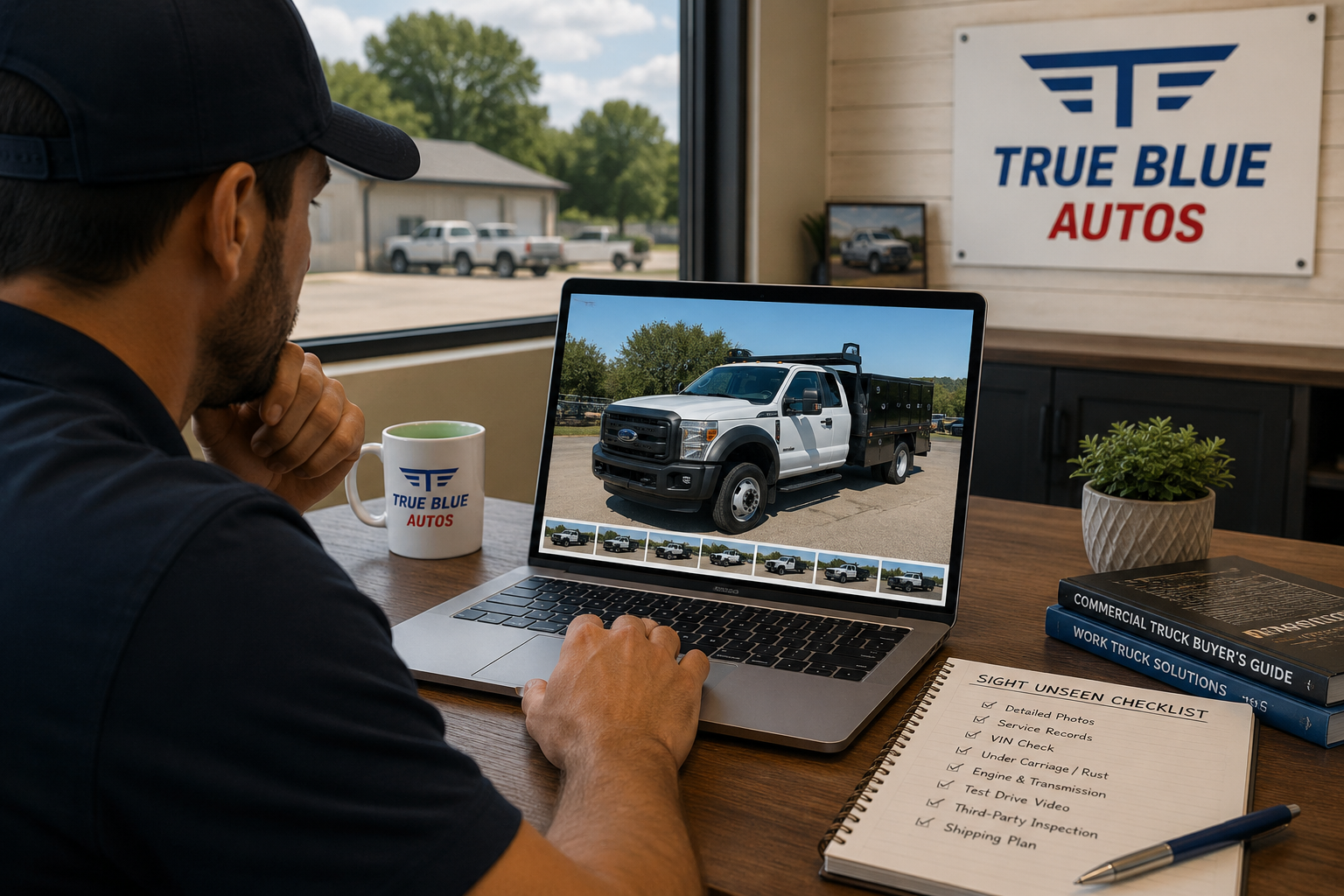
It’s a fair question — and probably one of the biggest hesitations buyers have before purchasing a work truck out of state. Handing over real money for a vehicle you’ve never walked around, sat in, or heard run feels like a leap of faith. The good news: buying sight unseen has become common and can be done safely, as long as you know what to check and who to trust. Here’s an honest look at the real risks, how to protect yourself, and why buying from a dealer changes the equation significantly compared to a private sale.
Why Sight-Unseen Buying Has Become So Common
This isn’t some fringe workaround anymore — it’s mainstream. In many cases, shoppers widen their search because local inventory is limited, especially for affordable used vehicles, and that trend has only accelerated as national listing sites make it easy to browse thousands of trucks at once. Cox Automotive reported that U.S. dealers had 2.13 million used vehicles in inventory in February 2026, equal to 42 days of supply — and vehicles priced below $15,000 had even tighter supply, at just 31 days. With fewer budget-friendly options sitting locally, more buyers are turning to nationwide listings and remote purchases simply to find the right truck at the right price.
Done carefully, this isn’t reckless — it’s just a different process with different checkpoints. Buying a car sight unseen means purchasing a vehicle without physically inspecting or test-driving it in person, relying instead on photos, videos, inspection reports, and conversations with the seller to evaluate its condition.
The Real Risks Worth Taking Seriously
It would be dishonest to pretend there’s no risk here. A handful of legitimate concerns come up again and again:
- Hidden mechanical or cosmetic issues. Without a hands-on look, you’re trusting someone else’s description and photos. If the vehicle arrives with problems, you might face a lengthy dispute process to seek a resolution — which is exactly why the verification steps below matter so much before money changes hands.
- Fraud, particularly from private sellers. This is where the real danger lives. Dishonest car sellers may claim to be too busy or far away to meet you, and may even offer a fake inspection report to convince you the vehicle is in working order — if it exists at all. Scammers specifically target buyers who never plan to see the vehicle in person, since a remote transaction gives them far more room to hide problems or disappear with a deposit.
- Title and lien issues. Always check for liens on the vehicle you intend to buy, since a lien gives a bank or lender legal claim to the truck for an unpaid debt — something that can create real headaches if it isn’t cleared before the sale closes.
- Odometer fraud. This is more common than most buyers realize. The National Highway Traffic Safety Administration estimates that more than 450,000 vehicles are sold annually with falsified odometer readings, a crime that costs American buyers over $1 billion a year — all the more reason to verify mileage independently rather than taking a listing at face value.
Why the Seller You’re Buying From Matters More Than Anything Else
This is the single biggest factor in how safe a sight-unseen purchase actually is. If you’re buying sight unseen, it’s generally more advantageous to do so from a dealer than a private seller, largely because you can much more easily verify the seller’s reputation. A licensed dealership has a physical address, a business history, online reviews, and accountability that a stranger on a classifieds site simply doesn’t.
Private-party sight-unseen deals carry the most risk by far. Serious buyers typically want to see a vehicle and ask questions before purchasing, and the same logic runs in reverse — a private seller who’s cagey about video calls, documentation, or answering direct questions is a red flag worth taking seriously, whether you’re the buyer or the seller in that scenario.
How to Protect Yourself Before You Buy
Whether you’re working with a dealer or a private party, a few concrete steps go a long way toward closing the gap that not seeing the truck in person leaves open:
- Get a vehicle history report. Request a detailed vehicle history report from a trusted provider such as Carfax or AutoCheck to check for accidents, title issues, flood damage, and mileage discrepancies before you commit to anything.
- Ask for real video, not just photos. A video walkaround gives you a much better sense of the vehicle’s actual condition than photos alone, and can reveal flaws that still images tend to hide — it also helps confirm the seller actually has physical access to the vehicle they’re describing.
- Arrange an independent inspection. This is arguably the single most valuable step you can take. Hire a trusted mechanic or third-party inspection service near the seller’s location to look the truck over before you finalize the deal — a professional inspection can catch issues that photos and a phone call never will.
- Verify the VIN and check for title problems. According to the National Insurance Crime Bureau, buyers should verify a vehicle’s VIN and check for title problems before purchasing a used vehicle online — a step that takes minutes and can save you from a costly title dispute down the road.
- Take your time. It’s tempting to rush once you’re ready to buy, but a short delay can uncover valuable facts about the dealer, warranty terms, or delivery conditions. Don’t let pressure to “act fast” push you past basic due diligence.
- Use a secure payment method. If you’re financing, get that lined up ahead of time. And regardless of how you’re paying, never wire money or share banking credentials directly with an individual seller — there’s never a legitimate reason for a seller to ask for your account credentials, even under the guise of receiving payment.
Red Flags That Should Make You Slow Down
A few warning signs are worth treating as hard stops, not minor annoyances:
- A seller who avoids video calls or refuses to answer specific questions about the truck’s condition or history.
- Pressure to pay immediately or skip an independent inspection to “lock in the deal.”
- Prices dramatically below market value. If something seems too good to be true, it probably is — an unusually low price relative to comparable listings is one of the clearest signals something’s off.
- A seller who insists on a specific inspector or inspection location. In some scams, fraudsters insist on a pre-purchase inspection done at a place of their choosing, then return a biased or fake report to pressure a lower price. Take control of the inspection process yourself.
- No verifiable business history. For a dealership, check reviews beyond the dealer’s own website — the Better Business Bureau, third-party review sites, and general search results can confirm whether a business has a real, consistent track record.
Why Buying From an Established Dealer Changes the Math
All of the risk described above assumes you’re navigating the process entirely on your own with a stranger. That calculation shifts considerably when you’re buying from a dealership with a physical location, a documented history, and a reputation to protect.
A reputable dealer typically has already done much of the verification work for you — pulling history reports, inspecting the vehicle, and standing behind the sale in a way an anonymous private seller simply can’t. It’s also worth remembering that reliable shipping support can make buying sight unseen far less stressful in general, since a trustworthy shipper adds another layer of documentation — inspection at pickup, inspection at delivery — on top of whatever the dealer has already verified.
Bottom Line
Buying a commercial truck you’ve never seen in person isn’t inherently risky — but buying one carelessly is. The combination of a documented vehicle history, an independent inspection, verified title status, and a seller with real accountability turns a sight-unseen purchase into a well-informed one rather than a gamble. The dealer you choose to work with matters just as much as the truck itself.
Buy With Confidence
At True Blue Autos, every truck in our inventory is inspected and detailed by our sister company, Enneking Auto Body, before it’s ever listed — and our team is happy to answer questions, share additional photos or video, and walk you through the truck’s history before you commit to anything.
1661 N Michigan Ave, Greensburg, IN 47240
Call: (812) 222-8783
Contact True Blue Autos
Reach out today — we’re here to answer every question before you buy, not just after.
Frequently Asked Questions
Is it actually safe to buy a truck sight unseen?
It can be, when done carefully. Buying sight unseen has become common as buyers search nationwide for the right vehicle at the right price, and with the right verification steps — history reports, video walkarounds, independent inspections — the risk can be managed effectively. The safety comes down more to who you’re buying from than the fact that you haven’t seen the truck in person.
What’s the biggest risk of buying a vehicle you haven’t seen?
Fraud from private sellers is the biggest concern. Dishonest sellers may claim to be too busy or far away to meet, and may even provide a fake inspection report to make a truck look better than it is. Buying from an established dealer with a real business history and accountability significantly reduces this risk compared to a private-party transaction.
Should I trust photos alone before buying?
No — always ask for real video in addition to photos. A video walkaround gives a much better sense of the vehicle’s actual condition than photos alone, and it also helps confirm the seller genuinely has physical access to the truck they’re describing.
Do I really need an independent inspection if I’m buying from a dealer?
It’s still a smart step, even with a reputable dealer, and it’s essential with a private seller. Hiring a trusted mechanic or third-party inspection service near the vehicle’s location can catch issues that photos and conversations never will — and it’s one of the most valuable protections you have in a remote purchase.
How do I check if a truck has a clean title?
Pull a vehicle history report from a trusted provider like Carfax or AutoCheck, and separately verify the VIN and check for title problems, since even a truck with a spotless-looking listing can carry an undisclosed lien or title issue.
What if I’m buying from a private seller instead of a dealer?
Take extra precautions. Verify the seller is who they say they are, ideally through a video call, and never send money through a wire transfer or share your banking credentials directly — there’s never a legitimate reason for a seller to request account access to receive payment.
What are the clearest red flags to watch for?
A seller who avoids video calls or dodges specific questions, pressure to pay immediately or skip an inspection, a price well below market value, or insistence on using a specific inspector of their choosing rather than one you select yourself. Any of these is a reason to slow down or walk away.
Why does buying from a dealership reduce the risk so much?
A licensed dealership has a physical address, a documented business history, and a reputation to protect — all things an anonymous private seller doesn’t have. Reputable dealers also typically handle much of the verification work upfront, including inspections and history reports, before a truck is ever listed for sale.
Does using a shipping company add any extra protection?
Yes, indirectly. A reliable shipper documents the vehicle’s condition at both pickup and delivery, which adds another layer of accountability on top of whatever verification the dealer has already done — giving you a paper trail if anything looks different once the truck arrives.
Is odometer fraud something I should actually worry about?
It’s more common than most buyers assume. The National Highway Traffic Safety Administration estimates over 450,000 vehicles are sold annually with falsified odometer readings, costing buyers more than $1 billion a year combined — which is exactly why an independent vehicle history report is worth running before every purchase, not just the ones that seem suspicious.
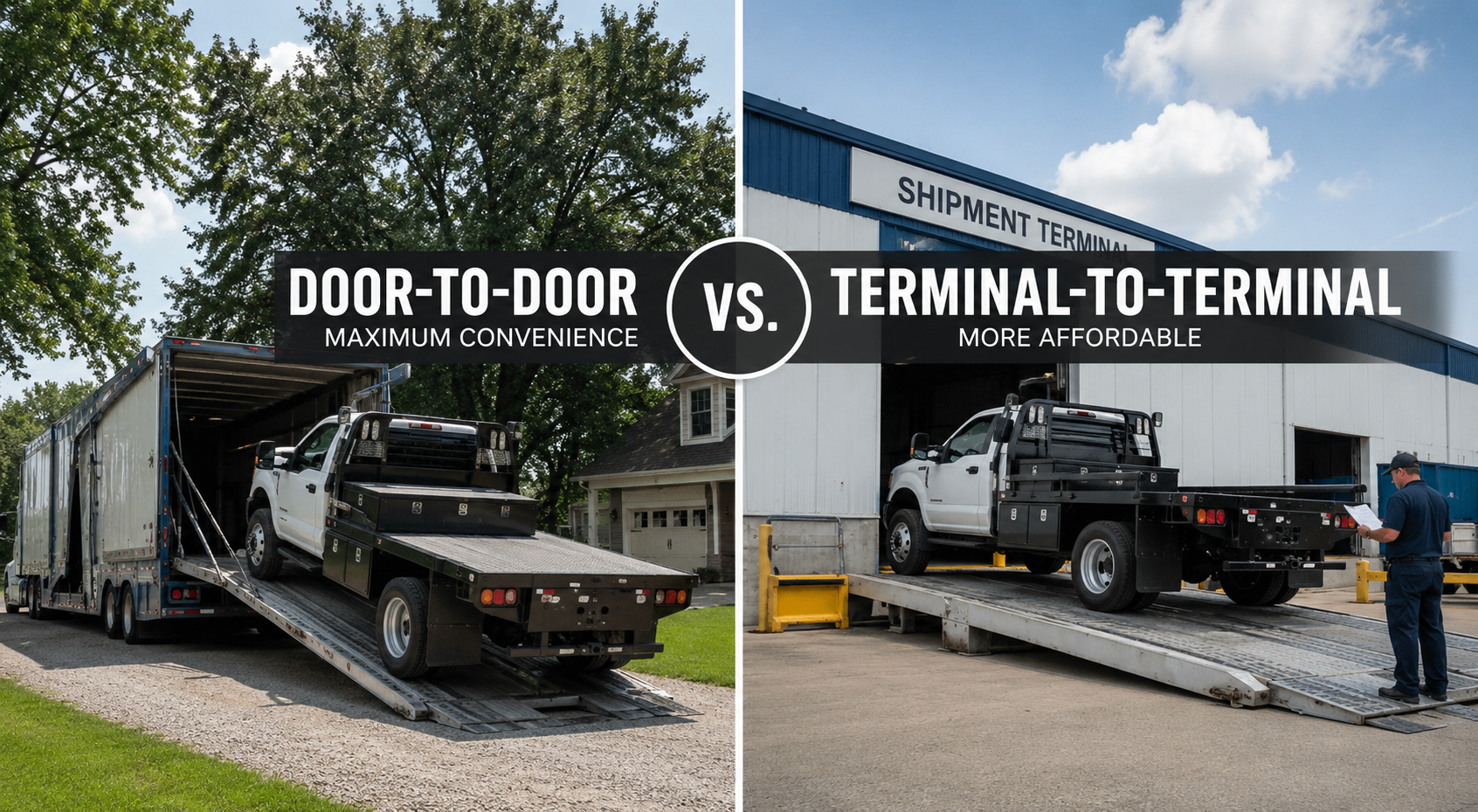
Once you’ve decided to ship a work truck instead of driving it home, there’s one more choice that affects both your cost and your convenience: door-to-door or terminal-to-terminal delivery. Both methods get your truck where it needs to go, but they work very differently, and picking the wrong one for your situation can mean unnecessary hassle or unnecessary cost. Here’s exactly how each one works and how to decide which makes more sense for your next truck purchase.
What Door-to-Door Shipping Actually Means
Door-to-door is exactly what it sounds like. In door-to-door car shipping, the carrier picks up and delivers your vehicle as close to your specified addresses as possible, often right to your driveway or street — eliminating the need to drive to or from a terminal yourself. The process is straightforward from the customer’s side: once your order is confirmed, your assigned carrier contacts you directly to arrange pickup details, then loads the truck at your location and delivers it to the address you specified.
This convenience extends to scheduling, too. It’s very common for carriers to pick up or deliver vehicles outside of traditional business hours — early morning, late evening, or even weekends — which is part of what makes door-to-door the most flexible method for working around a buyer’s schedule.
What Terminal-to-Terminal Shipping Actually Means
Terminal-to-terminal works differently. This method requires you to drop off and pick up your car at designated transport hubs known as terminals, rather than having the carrier come to your specific address. These terminals are typically fenced-in, secured yards, often located near airports or major highways, where carriers consolidate multiple vehicles before moving them in bulk between locations.
The tradeoff for that extra legwork is usually a lower price. This method can sometimes come at a lower price point because it requires less door-to-door logistics — though it entails more effort on your part to get your vehicle to and from the terminals.
The Cost Difference
Terminal-to-terminal is generally the cheaper of the two options, though the gap varies quite a bit by source and route. One estimate puts terminal shipping at $150–$250 less than door-to-door, depending on distance and demand, while another notes that terminal-to-terminal can cut costs by up to 30% compared to door-to-door service.
That said, the savings aren’t always as clean as they look on paper. Storage fees, often $25–$50 per day if you don’t pick up your truck promptly, can eat into what you saved by choosing the terminal option in the first place. And if the pickup and delivery locations are along interstates or in larger cities, the price difference may not be that much at all — the savings show up most when your route runs through rural or hard-to-access areas that would otherwise require the carrier to go out of their way for a direct delivery.
The Convenience Difference
This is really where the two methods diverge. Door-to-door minimizes your involvement almost entirely — your vehicle is picked up and delivered immediately with you being there, without the extra step of coordinating a separate trip to a facility.
Terminal-to-terminal asks more of you. Since you have to work on getting your vehicle to the terminal yourself and later pick it up from another terminal at the destination, this shipping method requires additional coordination and effort compared to door-to-door, especially if you’re not near a major hub already.
Location matters a lot here. Terminals are common near major cities but rare in rural areas, and reaching one may take hours in some parts of the country, which can add both time and hidden cost that offsets the lower sticker price of terminal shipping.
Speed: Door-to-Door Usually Wins
If timing matters to you, door-to-door tends to move faster overall. It’s typically 2–3 days faster than terminal shipping since your car doesn’t sit waiting for pickup or release at a facility — a truck sitting in a terminal yard, waiting for either you or the next leg of transport to arrive, adds dead time that a direct pickup and delivery simply avoids.
Which One Makes More Sense for a Work Truck?
For most buyers picking up a heavy-duty pickup, flatbed, or service truck, door-to-door tends to be the more practical choice, for a few reasons specific to how work trucks get used:
- You need the truck working, not sitting in a yard. A work truck is typically bought to go straight into service — hauling equipment, running a route, or getting a crew to a job site. Door-to-door transport is ideal for busy individuals, families relocating, car dealerships, and owners of high-value vehicles who prefer minimal handling and maximum care, and a business buyer waiting on a truck to start earning its keep fits squarely into that category.
- Terminal access isn’t guaranteed near where you actually work. Many businesses and job sites aren’t located near a major transport hub, which means the “savings” of terminal-to-terminal can get eaten up fast by drive time, fuel, and the hassle of coordinating a pickup trip during business hours.
- Less handling means less risk. With door-to-door shipping, your car stays with the carrier throughout the entire journey, reducing the risk of damage or theft that might occur at a terminal — a meaningful consideration on a truck you’re about to put straight to work and can’t afford to have sidelined for repairs before it even starts.
That said, terminal-to-terminal can still make sense in the right circumstances — particularly if you’re near a major city or interstate corridor where a terminal is genuinely convenient, or if you have flexible scheduling and want to shave a bit off the total cost. Terminal-to-terminal shipping requires you to drop off your vehicle at a designated terminal and pick it up from another terminal at the destination, and for buyers with the flexibility to work around that, it remains a legitimate way to save money.
Questions to Ask Before You Choose
Regardless of which method fits your situation, a few things are worth confirming with your shipper before booking:
- Is door-to-door actually available on my route? Some situations may prevent door-to-door service — residential zoning laws, weight restrictions, narrow streets, or low-hanging trees may prohibit large trucks from entering certain neighborhoods, in which case a nearby meeting point will be arranged instead.
- How far is the nearest terminal, really? If you’re leaning toward terminal-to-terminal to save money, confirm the actual distance and drive time before you commit — a terminal that’s “technically nearby” but still an hour or two away can quietly erase your savings.
- What are the storage fees if I can’t pick up right away? Ask upfront what the per-day storage cost looks like if your schedule doesn’t line up perfectly with your truck’s arrival at the terminal.
- What’s the real price difference for my specific route? The savings from terminal-to-terminal vary a lot by distance and location — get quotes for both methods before deciding, rather than assuming terminal is automatically cheaper.
Bottom Line
Door-to-door shipping trades a modestly higher price for speed, convenience, and less handling of your truck — a combination that usually makes sense for a work truck headed straight into daily use. Terminal-to-terminal can save real money, but it asks more of your time and only pays off cleanly if you’re near a terminal and have the flexibility to manage pickup and drop-off yourself.
Let Us Handle the Logistics
At True Blue Autos, we ship work trucks nationwide — everywhere except Alaska and Hawaii — and we’ll walk you through the right shipping method for your route, your budget, and your timeline before you ever commit to anything.
1661 N Michigan Ave, Greensburg, IN 47240
Call: (812) 222-8783
Contact True Blue Autos
Reach out today and let’s figure out the best way to get your next work truck home.
Frequently Asked Questions
What’s the basic difference between door-to-door and terminal-to-terminal shipping?
Door-to-door means the carrier picks up and delivers your vehicle as close to your specified addresses as possible, often right to your driveway. Terminal-to-terminal requires you to drop off and pick up your car at designated transport hubs instead, which means more coordination on your end but often a lower price.
Which option is cheaper?
Terminal-to-terminal is generally less expensive, though the exact savings vary by route. Some estimates put it at $150–$250 less than door-to-door, while others say it can cut costs by up to 30% depending on distance and demand. The savings tend to be biggest on routes through rural or hard-to-reach areas.
Are the terminal savings always worth it?
Not always. Storage fees, often $25–$50 per day if you don’t pick up the truck promptly, can eat into what you saved, and if your pickup and delivery points are already along interstates or in larger cities, the price difference between the two methods may not be significant at all.
Which method is faster?
Door-to-door is typically 2–3 days faster than terminal shipping, since your truck doesn’t sit waiting for pickup or release at a facility. That dead time at the terminal — waiting for either you or the next leg of transport — is what adds the extra days.
Is door-to-door available everywhere?
Not always. Some situations prevent door-to-door service — for example, residential zoning laws, weight restrictions, narrow streets, or low-hanging trees may keep a large truck from entering certain neighborhoods. In those cases, the carrier will arrange a nearby meeting point instead of your exact address.
Why would someone choose terminal-to-terminal instead?
It can make sense if you’re located near a major terminal already, have flexible scheduling, and want to shave some cost off the shipment. It also tends to work better for buyers who don’t need the truck immediately and don’t mind coordinating a separate pickup trip.
Is terminal-to-terminal shipping safe for the truck?
Generally yes — terminals are secure, fenced-in yards — but there’s a small added risk simply from extra handling and storage time compared to door-to-door, where the truck stays with the carrier the entire trip. For a truck you’re planning to put straight to work, minimizing handling is usually the safer bet.
Why does door-to-door usually make more sense for a work truck?
Work trucks are typically bought to go straight into service, so getting the truck delivered directly rather than sitting in a terminal yard means less downtime before it’s earning its keep. It also usually means less handling overall, which lowers the risk of damage before the truck ever gets to the job site.
What should I ask before choosing a shipping method?
Confirm whether door-to-door is actually available on your specific route, how far the nearest terminal is if you’re considering that option, what storage fees apply if you can’t pick up right away, and get quotes for both methods so you can compare the real price difference rather than assuming one is automatically cheaper.
Can I switch between the two if my plans change?
It’s best to decide before booking, since carriers plan routes and terminal space in advance. If your schedule or location changes, talk to your shipper as early as possible — they may be able to adjust, but last-minute changes can affect both cost and timing.
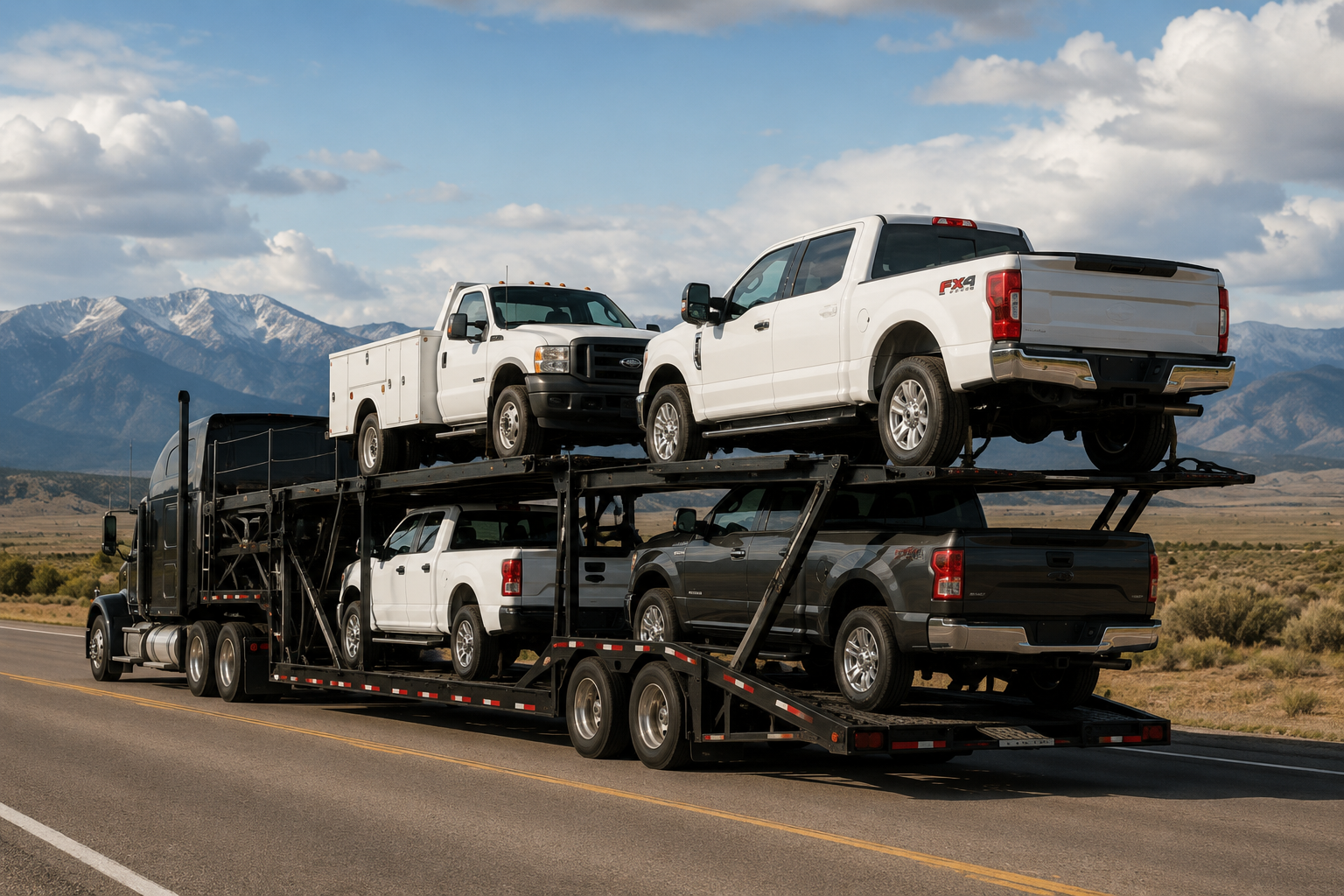
Once you’ve bought a work truck and locked in your shipping quote, the next question is almost always about timing: when is this thing actually going to show up? Unlike buying something online with a guaranteed two-day delivery window, truck shipping runs on estimates rather than fixed dates — and understanding why can save you a lot of frustration while you wait. Here’s a realistic breakdown of how nationwide truck shipping timelines actually work, from booking to delivery.
The Short Answer
Timing breaks down into two separate phases that people often lump together: the pickup window and the transit time. Car shipping typically starts a few days after you book, and most carriers provide a pickup window of three to five days from your reservation date — that’s the time it takes for a carrier to actually arrive and load your truck, which is separate from how long the drive itself takes. Once your truck is loaded, expect delivery to take anywhere from a few days to two weeks, depending on distance and route.
Put those two phases together, and cross country car shipping over 1,500 miles typically takes 7 to 14 days in transit, and once you add 1 to 3 days for booking and dispatch, most customers see door-to-door delivery in 10 to 17 days.
Why It’s an Estimate, Not a Guarantee
This trips people up more than any other part of the process. A car carrier can technically drive across the entire country in a little over four days, but that’s not how it actually works in practice — carriers have to make stops along the way to pick up and drop off other vehicles, since there can be up to 10 or 11 vehicles on a single truck, and they’re not usually all headed to the same city. Your truck is one stop on a route that’s serving several other customers at once.
Federal hours-of-service rules add another layer of predictability — and unpredictability. Federal regulations limit truck drivers to 11 consecutive hours behind the wheel per day, with mandatory rest breaks required to maintain safety standards, which means most auto transport carriers average 400-500 miles per day during cross-country hauls once you account for driver rest, fuel stops, and other pickups and deliveries along the way.
Because of all this, it’s considered a sign of bad faith if a transport company gives you a specific delivery date rather than an estimated window — legitimate carriers work in ranges, not guarantees, unless you’re paying extra for an expedited or guaranteed service.
Timelines by Distance
Transit time is driven primarily by how far the truck is traveling. Here’s roughly what to expect once your truck is actually loaded and moving:
- Under 500 miles: Open auto shipping for distances under 500 miles usually completes within 3-7 days on average.
- 500–1,000 miles: Shipments between 500-1,000 miles take a bit longer at 5-10 days to account for the additional road transit time.
- 1,000–1,500 miles: Standard open shipping deliveries for moves in the 1,000-1,500 mile range span about 7-14 days end-to-end.
- 1,500+ miles (true cross-country): For long-distance car transport routes over 1,500 miles, open shipping transit often completes in a 14-21 day range on average.
- True coast-to-coast (2,500–3,000 miles): The standard answer for coast to coast shipping time is 7-10 days of actual transit, with coast-to-coast auto transport covering approximately 2,500 to 3,000 miles total.
A simple rule of thumb some shippers use: generally, every five hundred miles adds roughly one day to the transit time, which gives you a quick way to ballpark your own route before requesting a formal quote.
What Slows Shipments Down
A handful of factors can extend your timeline beyond the baseline estimate:
- Rural pickup or delivery locations. Deliveries to rural or remote areas can take longer than major metro routes, since drivers on major interstate corridors run daily service while less-traveled areas require the carrier to go out of their way. If your final delivery point is off the beaten path, meeting the driver at the nearest major hub can shave meaningful time off the last leg of the trip.
- Enclosed transport. If you’re shipping something that requires enclosed transport rather than standard open transport, budget more time — enclosed carriers move fewer cars and are less available than open carriers, which adds time to both the pickup window and the overall delivery estimate. For most work trucks, sticking with open transport keeps things moving faster in addition to being cheaper.
- Seasonal demand. Summer months and holidays tend to have longer lead times due to high booking volume, since more people are moving and shipping vehicles at the same time, which stretches carrier availability thin.
- Weather and road conditions. Severe weather or road closures can delay shipments by a few days, and traffic congestion in major cities can add a day or two to transit time as well — most carriers build a small buffer into their estimates to account for this.
- Weekends and holidays. Most auto transport carriers don’t operate on weekends or major holidays, which can extend your total delivery time by a few days if your pickup or delivery window happens to overlap with one.
How the Process Actually Unfolds
Knowing the general sequence of events helps set realistic expectations for what “shipping” actually looks like day to day:
- Booking and matching. Once you book, the shipping company works to match your route with a carrier already running that direction. Placing your reservation about two weeks in advance gives the company plenty of time to find a carrier going your way, and can shorten your delivery window and sometimes even lower your cost.
- Pickup window. The carrier will arrive at your home or a nearby terminal on the scheduled day, and you’ll inspect the truck together and note its condition on the Bill of Lading before it’s loaded.
- Transit. While your truck is in transit, you can often track progress via GPS or carrier updates provided by the shipping company, giving you visibility into where things stand along the route.
- Delivery. Your driver will typically contact you with an estimated arrival window 24-48 hours before reaching your area, then confirm your delivery location and coordinate a convenient time for final inspection and paperwork. When it arrives, inspect the truck carefully and compare it to the Bill of Lading before signing off — if you notice anything off, document it immediately and contact the carrier.
How to Speed Things Up
If timing matters to you, a few practical levers can help:
- Book early. Two to four weeks ahead of your ideal pickup date gives the shipper the widest pool of carriers to match you with.
- Stick with open transport. It’s both faster and cheaper than enclosed transport since more trucks run open routes, and there are roughly nine open transport trucks on the road for every enclosed trailer.
- Be near a major metro area or highway corridor if possible. Vehicles near a major city typically get picked up in a day or two, while ones off the beaten path generally take a day or two longer just to get loaded.
- Ask about guaranteed or expedited pickup. If your timeline is tight, some shippers offer guaranteed pickup dates or expedited service within one to two business days, though this typically comes at a higher cost.
- Avoid peak season if your dates are flexible. Off-peak seasons, such as November through March, often bring increased carrier availability and potentially shorter transit times, since overall shipping demand is lower.
Setting Realistic Expectations
The honest takeaway here: shipping a truck coast to coast is genuinely a one-to-two-week process in most cases, not a next-day delivery. That said, it’s still almost always faster, less stressful, and easier on the vehicle than driving it yourself across the country — especially for a truck you’re about to put straight to work. Understanding the pickup window versus transit time distinction, and building in a little buffer for weather or seasonal demand, will keep the process predictable rather than frustrating.
Ready to Get Your Next Truck Moving?
At True Blue Autos, we ship work trucks nationwide — everywhere except Alaska and Hawaii — and our team will give you a clear, honest timeline before you ever commit to a purchase. No vague promises, no guessing games about when your truck will actually show up.
1661 N Michigan Ave, Greensburg, IN 47240
Call: (812) 222-8783
Contact True Blue Autos
Reach out today and let’s get your next work truck on the road — and to your door.
Frequently Asked Questions
How long does nationwide truck shipping typically take?
For cross country shipping over 1,500 miles, expect 7 to 14 days in transit, plus 1 to 3 days for booking and dispatch — most customers see door-to-door delivery in 10 to 17 days total. Shorter routes take less time, while true coast-to-coast shipments tend to land toward the higher end of that range.
What’s the difference between the pickup window and transit time?
They’re two separate phases. Most carriers provide a pickup window of three to five days from your reservation date — that’s how long it takes for a carrier to actually arrive and load your truck. Transit time is the separate clock that starts once your truck is loaded and on the road, and it’s driven mainly by distance.
Why can’t a shipping company just give me an exact delivery date?
Because your truck isn’t traveling alone. There can be up to 10 or 11 vehicles on a single carrier, and they’re not usually all headed to the same destination, so the driver makes multiple stops along the route. It’s actually considered a sign of bad faith if a company promises a specific delivery date rather than an estimated window, unless you’re paying for a guaranteed or expedited service.
How long does a short regional shipment take compared to a cross-country one?
Distance drives almost everything. Under 500 miles usually completes within 3-7 days, 500-1,000 miles takes about 5-10 days, and a true cross-country move over 1,500 miles typically runs 14-21 days for open transport. A simple rule of thumb: every five hundred miles adds roughly one day to transit time.
Does the type of transport affect how long shipping takes?
Yes. Enclosed carriers move fewer cars and are less available than open carriers, which adds time to both the pickup window and overall delivery. Since most work trucks ship via open transport anyway, this usually isn’t a concern — open transport is both faster and cheaper for the kind of pickups, flatbeds, and service trucks we sell.
What can delay my shipment?
A few common culprits: rural pickup or delivery locations that are off major routes, severe weather or road closures, high seasonal demand (especially summer months and holidays), and weekends or holidays when most carriers don’t operate. Good carriers build a small buffer into their estimates to account for these.
Can I speed up delivery if I need the truck faster?
A few things help: booking two to four weeks ahead gives the shipper more carrier options, sticking with open transport is inherently faster than enclosed, and being located near a major metro area or highway corridor typically means faster pickup. Some companies also offer guaranteed or expedited pickup for an added cost if your timeline is tight.
How will I know when my truck is actually going to arrive?
Most carriers provide tracking during transit and will contact you directly as delivery gets close — typically with an estimated arrival window 24-48 hours before reaching your area, followed by a more specific call as the driver gets closer. Make sure you or a trusted representative are available to inspect the truck and complete paperwork at delivery.
Is it faster to just drive the truck myself?
Technically, yes — a straight drive takes far less time than shipping, since a carrier realistically only covers about 400-500 miles per day due to federal hours-of-service rules and multiple stops along the route. But for longer distances, shipping saves you the time, fuel, and wear of driving it yourself, and the truck arrives ready to work instead of already racking up mileage.
Should I book shipping before or after I finalize the truck purchase?
Once your purchase is confirmed, booking shipping as early as possible works in your favor. Placing your reservation about two weeks in advance gives the shipping company time to match your route with the right carrier, which can shorten your delivery window and sometimes even improve your rate.